Showing posts with label recipe. Show all posts

Friday, September 9, 2011

Okra pachadi

Most of the recipes on this blog are my own, but sometimes I want to share others I’ve stumbled across, or those that people have sent to me. This pachadi recipe comes from Sharmila, a local food blogger who does Very Good Things with yoghurt and okra.
In my limited experience, a pachadi appears to be a base of yoghurt and vegetables, topped with a mixture of tempered spices; like pouring a tarka over a dahl. It’s clearly South Indian, as mustard seeds and curry leaves feature heavily in many recipes. My first chapadi experience came via Flickr when one of my contacts posted a recipe so unusual to my eyes that I had to have it. Mustard seeds, dried chilli and curry leaves are fried briefly in coconut oil until the seeds pop then mixed with yoghurt and cucumber. It’s hard to resist bombing a hot chapatti into the still-sizzling spiced oil. The flavours will have you on the edge of your seat.
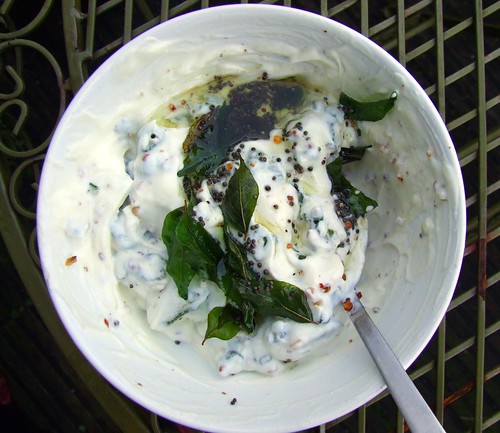
Sharmila’s version is made using okra slices, fried until crisp; a beautiful contrast against the chilled yoghurt. It takes minutes to make and I can particularly recommend it as part of a ‘curry day’ extravaganza; nargisi kofta curry, chicken tikka and this excellent spinach and paneer dish from Das Sreedharan’s hugely under-rated book, ‘Indian’*. Yes, I know I go on about that book all the time.
Okra pachadi
1 teaspoon black mustard seeds
10 or so curry leaves
2-3 green chillies, chopped into a few pieces
Chilli powder
Lemon juice
Coriander leaves
Two large handfuls of okra, chopped up into smallish (2cm pieces)
Natural yoghurt
Salt to taste
Groundnut oil
Fry the okra in a few tablespoons of groundnut oil until nice and crisp. Drain on kitchen paper.
Combine the okra with the yoghurt (about 200g) and a bit of chilli powder (but not too much – this isn’t a spicy dish). Fry the mustard seeds in a small pan in a tablespoon or so of oil. When they start to pop, add the green chilli and curry leaves. When they are nicely sizzling, pour over the yoghurt mixture. Stir to combine, add salt and lemon juice to taste and then add the coriander leaves.
* The edition of Das’ book that I have doesn’t seem to be available any more but this looks very similar and I imagine will have a lot of the same recipes. It’s one of those books you actually cook from rather than just flick through.
Thanks again to Sharmila for the chapadi recipe.

New baba ganoush recipe

  The way to get good at cooking is to go at recipes over and over, not flit around from one place to another and never look back.
I ate a stunning baba ganoush at Maramia Cafe recently as part of a ‘lamb banquet’ organised by Carla. The meat was soft and tasty as hell, but the baba was what really blew people’s minds. It was thicker than mine; I wondered how they’d achieved the consistency and considered straining the yoghurt. I’m a serial strainer – you end up with something almost cream cheese-y but way more refreshing. I tried using it in the baba and the result was of course, richer. I’ve also started using smaller aubergines, which means that the smoke can penetrate all the flesh, rather than just the outer layer.

That’s it really – makes all the difference.
Baba Ganoush
8 small aubergines
2 cloves garlic, crushed
2 lemons (juice)
1 handful mint leaves, chopped
1 handful coriander or parsley leaves (or a little of both), chopped
6-8 tablespoons tahini (I like a good whack but you may want less)
1-2 tablespoons pomegranate molasses
Salt and pepper
4 tablespoons olive oil (not extra virgin)
4 tablespoons strained yoghurt (see below)
First, strain the yoghurt. If you don’t remember to do this the night before it doesn’t matter, even a couple of hours will make a big difference and the process itself takes seconds of preparation. Take a 500g tub of decent Greek-style yoghurt such as Total. Full-fat will obviously taste better than low fat but the latter does work okay. You’ll need some butter muslin, which is available from hardware stores easily. Cut a square of the muslin and line a bowl with it. Mix the yoghurt with a scant teaspoon of salt, mix well, then dollop it all into the middle of the muslin in the bowl. Gather it up, tie string around the top then tie the other end to something (I use a kitchen cupboard handle). Leave it for a few hours or ideally, overnight with the bowl underneath.
Pierce the aubergines with a fork and place directly on the gas rings of a hob (1 per ring) on a low flame, or put them under the grill, turning occasionally until blackened all over and collapsed. They will burst but this is fine, it just requires a bit of attention so you don’t lose the flesh. Remove to a plate and let cool slightly, then scrape the flesh from inside, leaving any bits of blackened skin and liquid on the plate behind.
Blend with all the other ingredients and season and adjust as necessary. You may want to add more lemon, yoghurt or salt for example.
Allow to sit for a few hours before serving with hot flat breads or pitta for scooping.

Tuesday, August 30, 2011

Honey-Chipotle Pecans

  • 2 tablespoons honey
  • 1 1/2 teaspoons dried chipotle powder
  • 3/4 teaspoon ground cinnamon
  • 2 cups pecan halves
  • 2 tablespoons sugar
  • 3/4 teaspoon salt

Directions:


  1. 1
    Preheat oven to 325°F.
  2. 2
    In a skillet, warm honey with chipotle powder and cinnamon over low heat, then add the nuts and stir to coat evenly.
  3. 3
    Line a baking sheet with waxed paper, then spread nuts evenly in a single layer on the sheet.
  4. 4
    Bake in preheated oven until nuts are fragrant (10-15 minutes).
  5. 5
    Allow to cool slightly (1 minute).
  6. 6
    In a mixing bowl, combine sugar and salt.
  7. 7
    Add the warm pecans, and toss to coat evenly.
  8. 8
    Spread out on fresh sheet of waxed paper and let dry completely.
  9. 9
    Store in an airtight container.